




BWW Stage Mag The Fate of Lenore - The Backlot Stage Mag

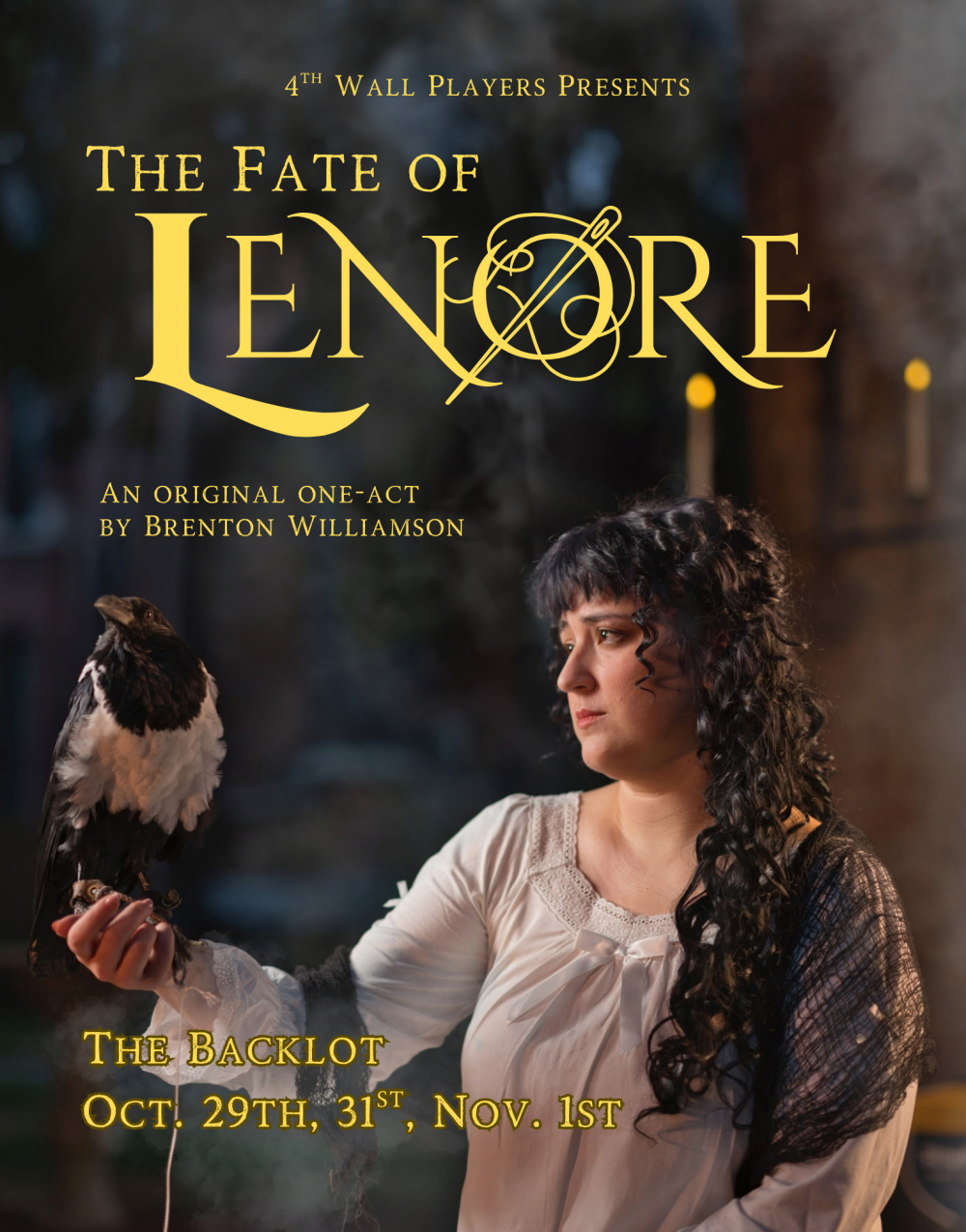
The Fate of Lenore

 
at The Backlot
 
 
by
Brenton Williamson
 
Starring
 
Eliza Sandlin
Aprille Goodman
Andy Hoffman
Amy Frazer
Derrick Krober
Jeff Goltz

Director's Note


Sometimes, an idea won’t leave you alone. In summer 2025, 4th Wall Players posted a writing contest with a simple pitch: who was Lenore? Who was this mysterious woman in Poe’s famous poems?


I was far too busy. I’d only dabbled in playwriting, never anything serious. Sure, I was familiar with the poems, and as an English teacher, I’ve taught several of them. But I was in the middle of another Gwendolyn Gray novel, and I had deadlines to hit.


But… who was Lenore? What would be my take? I reread the Raven. And Lenore. And Annabel Lee. And I saw a pattern of a heartbroken lover, yearning for his perfect, precious maiden. But who was she? There was never the slightest hint as to any sort of character or personality.


The engine of a good story is its conflict. And what if Lenore’s absence from the text was the central conflict? What if his neglect was the cause of her death?


Obviously such a thing isn’t really possible. But it was enough to make me take another look at the poems, and Poe’s life. I was struck by what a gross person he was. I noticed all of the references to mythology, which is another passion of mine. And the pieces clicked into place. It didn’t hurt that I had just read John Green’s Everything is Tuberculosis as well, and had consumption on the brain.


As a creator, I know how to recognize the critical mass of one idea leading to another leading to another. When there’s a snowball, there might be an avalanche. And when the final scene began to take shape, I knew I had something special. Something too good to leave stuck in a drawer, even if I didn’t win the contest. Finally, after a few failed pitches in various places to get this show on stage, Josh from 4th Wall Players expressed interest in it for a Halloween show this year.


And that’s how we arrive at this wonderful show, with the best cast and crew a director could ask for. Everyone involved has poured their hard work, passion, and talent into this show. No one ever treated it as a simple one-act staged in a converted garage. The phrase “Am I overthinking this?” was spoken by most of us at some point, and quickly became taboo. This story deserved every drop we could squeeze out of it.


Because Lenore deserved it. Lenore needed to be heard.

Cast

Eliza Sandlin
Lenore
Andy Hoffman
Guy de Vere
Dereck Krober
Edgar
Aprille Goodman
Decima
Amy Frazer
Morta
Jeff Goltz and Denni
The Raven

Creative Team

Brenton Williamson

Director

Dan Shockley

Assistant Director

Oli Reed

Technical Director

Hannah Roberts

Stage Crew

Jonah Craine

Stage Crew

Kori Williamson

Sets and Costumes

Kim Smerdel

Painting

Meet the Company

Eliza Sandlin

Lenore
Eliza Sandlin - Lenore

Eliza is thrilled to be making her theatrical debut in Indianapolis! She’s come such a long way since her second-grade debut as ensemble in James and the Giant Peach, circa 2002. Like every other goth teen, Eliza spent many a midnight dreary poring over Poe's poems. Little did she know that years later, she’d have the chance to spin this thread as Lenore herself. She thanks her mom, who has sat in the audience for over twenty years (and counting) and has always encouraged her to be one of the weirdos. This one goes out to all of the women who have ever felt trapped, unseen, or lost behind a door she longs to open. May we shrink and wither nevermore.

Andy Hoffman

Guy de Vere
Andy Hoffman - Guy de Vere

Andy has spent years public speaking, performing roles for various independent productions. He is an accomplished photographer, and competent guitarist. “The Fate of Lenore” is an exciting challenge: to dive into a creative side of theatrical performance alongside all of the extremely talented individuals bringing this show to the stage, during the Irvington Halloween Festival.

Dereck Krober

Edgar
Dereck Krober - Edgar

Derrick is enjoying his debut with Fourth Wall Players. He has previously appeared in Garfield Shakespeare Company as Richard III, the Porter in...the Scottish Play and his dream role as Renfield in Dracula. Derrick sends out all due dedication to his wife Kim and Mr. Poe himself. "The play is the tragedy, 'Man', and its hero, the Conqueror Worm."

Aprille Goodman

Decima
Aprille Goodman - Decima

Originally from small-town Tennessee, Aprille is a singer-songwriter who now calls Indianapolis home. After college in Nashville, she spent a decade in New York City, collaborating with musicians across the jazz, blues, rock, and folk worlds, as well as contributing music to film and television. Since moving to Indianapolis with her husband and two sons in 2020, she has happily rekindled her love of theatre. In 2024, she received Encore Association awards for Best Singer and Best Performance in a Leading Role for her portrayal of Alice Murphy in Footlite Musicals' Bright Star. She is grateful to be part of bringing this wonderfully strange and haunting new work to the stage.

Amy Frazer

Morta
Amy Frazer - Morta

Amy is excited to be performing in her first production with 4th Wall Players in beautiful Irvington where she grew up! Amy always intended to make the stage her life’s work, but instead she somehow became a psychiatric nurse for 50 years. She has really embraced performing music and theater since retirement. Favorite roles include Megaera in Androcles and the Lion, Madame Arcati in Blithe Spirit, Charlotte Wallace in Beyond Therapy, Beatrice Shelton in Four Old Broads, and most recently as Martha Brewster in Arsenic and Old Lace. Many thanks to Brent for the opportunity to help bring his creation to life, and to Bruce for his continued support of her need to perform.

Jeff Goltz and Denni

The Raven

Brenton Williamson

Director

Dan Shockley

Assistant Director

Oli Reed

Technical Director

Hannah Roberts

Stage Crew

Jonah Craine

Stage Crew

Kori Williamson

Sets and Costumes

Kim Smerdel

Painting

References and Background


Poe: Edgar Allan Poe was a renowned drunkard and debtor who wooed and married his thirteen-year-old cousin when he was in his late twenties, frequently calling her “my child”. He was later rocked with scandal and accusations of adultery, and after vanishing following his wife’s death from consumption, was discovered drunk, disheveled, and insensate in a tavern, whereafter he shortly died. He also wrote some pretty good poems. 


Poe’s Poems: The Raven and Lenore both reference a mysterious beauty named Lenore, whose death shattered the narrator, but no details are given about her person other than her endless beauty. Similar themes can be found in Annabel Lee. His poems are also rife with references to Greek and Roman mythology.


The Fates: The idea of three women controlling the fate of the universe spans various cultures. In Greek, they were the Moirai, named Clotho, Lachesis, and Atropos, who spin, measure, and cut the threads of life. In Rome, they were the Parcae, and named Nona, Decima, and Morta. In Norse mythology, the Norns shape fate, with Uror, Verdandi, and Skuld representing the past, present in future. In Paganism and Wicca, the three aspects of the Triple Goddess are the maiden, the mother, and the crone.


The Underworld: Hades realm is expansive. The river Styx must be crossed to enter the realm of the dead. The river Lethe was the river of oblivion. Souls drank from it and forgot their old lives. Apart from Tartarus, the realm of punishment, and the Elysian Isles of the blessed, the Meadows of Asphodel are a vast land, pale and ghostly, the destination of most souls. It is in these meadows that the fates are said to dwell.


The Furies - The three goddesses of vengeance, relatives to the fates


The Muses - The nine patrons of the arts and sciences, and source of inspiration. Calliope was the muse of epic poetry, and Clio was the muse of history.


Ravens: Apollo (also known as Phoebus) was associated with ravens, and they were used by the gods as messengers to the mortal world. Famously, the norse god-king Odin had two ravens, Hugin and Munin (thought and memory), serving as his eyes and ears in the mortal world. 

The Raven


The Raven

By Edgar Allan Poe

Once upon a midnight dreary, while I pondered, weak and weary,

Over many a quaint and curious volume of forgotten lore—

    While I nodded, nearly napping, suddenly there came a tapping,

As of some one gently rapping, rapping at my chamber door.

“’Tis some visitor,” I muttered, “tapping at my chamber door—

            Only this and nothing more.”


    Ah, distinctly I remember it was in the bleak December;

And each separate dying ember wrought its ghost upon the floor.

    Eagerly I wished the morrow;—vainly I had sought to borrow

    From my books surcease of sorrow—sorrow for the lost Lenore—

For the rare and radiant maiden whom the angels name Lenore—

            Nameless here for evermore.


    And the silken, sad, uncertain rustling of each purple curtain

Thrilled me—filled me with fantastic terrors never felt before;

    So that now, to still the beating of my heart, I stood repeating

    “’Tis some visitor entreating entrance at my chamber door—

Some late visitor entreating entrance at my chamber door;—

            This it is and nothing more.”


    Presently my soul grew stronger; hesitating then no longer,

“Sir,” said I, “or Madam, truly your forgiveness I implore;

    But the fact is I was napping, and so gently you came rapping,

    And so faintly you came tapping, tapping at my chamber door,

That I scarce was sure I heard you”—here I opened wide the door;—

            Darkness there and nothing more.


    Deep into that darkness peering, long I stood there wondering, fearing,

Doubting, dreaming dreams no mortal ever dared to dream before;

    But the silence was unbroken, and the stillness gave no token,

    And the only word there spoken was the whispered word, “Lenore?”

This I whispered, and an echo murmured back the word, “Lenore!”—

            Merely this and nothing more.


    Back into the chamber turning, all my soul within me burning,

Soon again I heard a tapping somewhat louder than before.

    “Surely,” said I, “surely that is something at my window lattice;

      Let me see, then, what thereat is, and this mystery explore—

Let my heart be still a moment and this mystery explore;—

            ’Tis the wind and nothing more!”


    Open here I flung the shutter, when, with many a flirt and flutter,

In there stepped a stately Raven of the saintly days of yore;

    Not the least obeisance made he; not a minute stopped or stayed he;

    But, with mien of lord or lady, perched above my chamber door—

Perched upon a bust of Pallas just above my chamber door—

            Perched, and sat, and nothing more.


Then this ebony bird beguiling my sad fancy into smiling,

By the grave and stern decorum of the countenance it wore,

“Though thy crest be shorn and shaven, thou,” I said, “art sure no craven,

Ghastly grim and ancient Raven wandering from the Nightly shore—

Tell me what thy lordly name is on the Night’s Plutonian shore!”

            Quoth the Raven “Nevermore.”


    Much I marvelled this ungainly fowl to hear discourse so plainly,

Though its answer little meaning—little relevancy bore;

    For we cannot help agreeing that no living human being

    Ever yet was blessed with seeing bird above his chamber door—

Bird or beast upon the sculptured bust above his chamber door,

            With such name as “Nevermore.”


    But the Raven, sitting lonely on the placid bust, spoke only

That one word, as if his soul in that one word he did outpour.

    Nothing farther then he uttered—not a feather then he fluttered—

    Till I scarcely more than muttered “Other friends have flown before—

On the morrow he will leave me, as my Hopes have flown before.”

            Then the bird said “Nevermore.”


    Startled at the stillness broken by reply so aptly spoken,

“Doubtless,” said I, “what it utters is its only stock and store

    Caught from some unhappy master whom unmerciful Disaster

    Followed fast and followed faster till his songs one burden bore—

Till the dirges of his Hope that melancholy burden bore

            Of ‘Never—nevermore’.”


    But the Raven still beguiling all my fancy into smiling,

Straight I wheeled a cushioned seat in front of bird, and bust and door;

    Then, upon the velvet sinking, I betook myself to linking

    Fancy unto fancy, thinking what this ominous bird of yore—

What this grim, ungainly, ghastly, gaunt, and ominous bird of yore

            Meant in croaking “Nevermore.”


    This I sat engaged in guessing, but no syllable expressing

To the fowl whose fiery eyes now burned into my bosom’s core;

    This and more I sat divining, with my head at ease reclining

    On the cushion’s velvet lining that the lamp-light gloated o’er,

But whose velvet-violet lining with the lamp-light gloating o’er,

            She shall press, ah, nevermore!


    Then, methought, the air grew denser, perfumed from an unseen censer

Swung by Seraphim whose foot-falls tinkled on the tufted floor.

    “Wretch,” I cried, “thy God hath lent thee—by these angels he hath sent thee

    Respite—respite and nepenthe from thy memories of Lenore;

Quaff, oh quaff this kind nepenthe and forget this lost Lenore!”

            Quoth the Raven “Nevermore.”


    “Prophet!” said I, “thing of evil!—prophet still, if bird or devil!—

Whether Tempter sent, or whether tempest tossed thee here ashore,

    Desolate yet all undaunted, on this desert land enchanted—

    On this home by Horror haunted—tell me truly, I implore—

Is there—is there balm in Gilead?—tell me—tell me, I implore!”

            Quoth the Raven “Nevermore.”


    “Prophet!” said I, “thing of evil!—prophet still, if bird or devil!

By that Heaven that bends above us—by that God we both adore—

    Tell this soul with sorrow laden if, within the distant Aidenn,

    It shall clasp a sainted maiden whom the angels name Lenore—

Clasp a rare and radiant maiden whom the angels name Lenore.”

            Quoth the Raven “Nevermore.”


    “Be that word our sign of parting, bird or fiend!” I shrieked, upstarting—

“Get thee back into the tempest and the Night’s Plutonian shore!

    Leave no black plume as a token of that lie thy soul hath spoken!

    Leave my loneliness unbroken!—quit the bust above my door!

Take thy beak from out my heart, and take thy form from off my door!”

            Quoth the Raven “Nevermore.”


    And the Raven, never flitting, still is sitting, still is sitting

On the pallid bust of Pallas just above my chamber door;

    And his eyes have all the seeming of a demon’s that is dreaming,

    And the lamp-light o’er him streaming throws his shadow on the floor;

And my soul from out that shadow that lies floating on the floor

            Shall be lifted—nevermore!


Lenore (Poem)

Lenore

By Edgar Allan Poe


Ah broken is the golden bowl! the spirit flown forever!
Let the bell toll!—a saintly soul floats on the Stygian river;
And, Guy De Vere, hast  thou no tear?—weep now or never more!
See! on yon drear and rigid bier low lies thy love, Lenore!
Come! let the burial rite be read—the funeral song be sung!—
An anthem for the queenliest dead that ever died so young—
A dirge for her the doubly dead in that she died so young.


“Wretches! ye loved her for her wealth and hated her for her pride,
“And when she fell in feeble health, ye blessed her—that she died!
“Howshallthe ritual, then, be read?—the requiem how be sung
“By you—by yours, the evil eye,—by yours, the slanderous tongue
“That did to death the innocent that died, and died so young?”


Peccavimus; but rave not thus! and let a Sabbath song
Go up to God so solemnly the dead may feel so wrong!
The sweet Lenore hath “gone before,” with Hope, that flew beside
Leaving thee wild for the dear child that should have been thy bride—
For her, the fair and  debonair,  that now so lowly lies,
The life upon her yellow hair but not within her eyes—
The life still there, upon her hair—the death upon her eyes.


“Avaunt! to-night my heart is light. No dirge will I upraise,
“But waft the angel on her flight with a Pæan of old days!
“Letnobell toll!—lest her sweet soul, amid its hallowed mirth,
“Should catch the note, as it doth float up from the damnéd Earth.
“To friends above, from fiends below, the indignant ghost is riven—
“From Hell unto a high estate far up within the Heaven—
“From grief and groan, to a golden throne, beside the King of Heaven.”

Annabel Lee

Annabel Lee

Edgar Allan Poe


It was many and many a year ago,
   In a kingdom by the sea,
That a maiden there lived whom you may know
   By the name of Annabel Lee;
And this maiden she lived with no other thought
   Than to love and be loved by me.


I was a child and she was a child,
   In this kingdom by the sea:
But we loved with a love that was more than love—
   I and my Annabel Lee;
With a love that the winged seraphs of heaven
   Coveted her and me.


And this was the reason that, long ago,
   In this kingdom by the sea,
A wind blew out of a cloud, chilling
   My beautiful Annabel Lee;
So that her highborn kinsman came
   And bore her away from me,
To shut her up in a sepulchre
   In this kingdom by the sea.


The angels, not half so happy in heaven,
   Went envying her and me—
Yes!—that was the reason (as all men know,
   In this kingdom by the sea)
That the wind came out of the cloud by night,
   Chilling and killing my Annabel Lee.


But our love it was stronger by far than the love
   Of those who were older than we—
   Of many far wiser than we—
And neither the angels in heaven above,
   Nor the demons down under the sea,
Can ever dissever my soul from the soul
   Of the beautiful Annabel Lee:


For the moon never beams, without bringing me dreams
   Of the beautiful Annabel Lee;
And the stars never rise, but I feel the bright eyes
   Of the beautiful Annabel Lee;
And so, all the night-tide, I lie down by the side
Of my darling—my darling—my life and my bride,
   In her sepulchre there by the sea,
   In her tomb by the sounding sea.

Learn More About Stage Mag