|
|
||
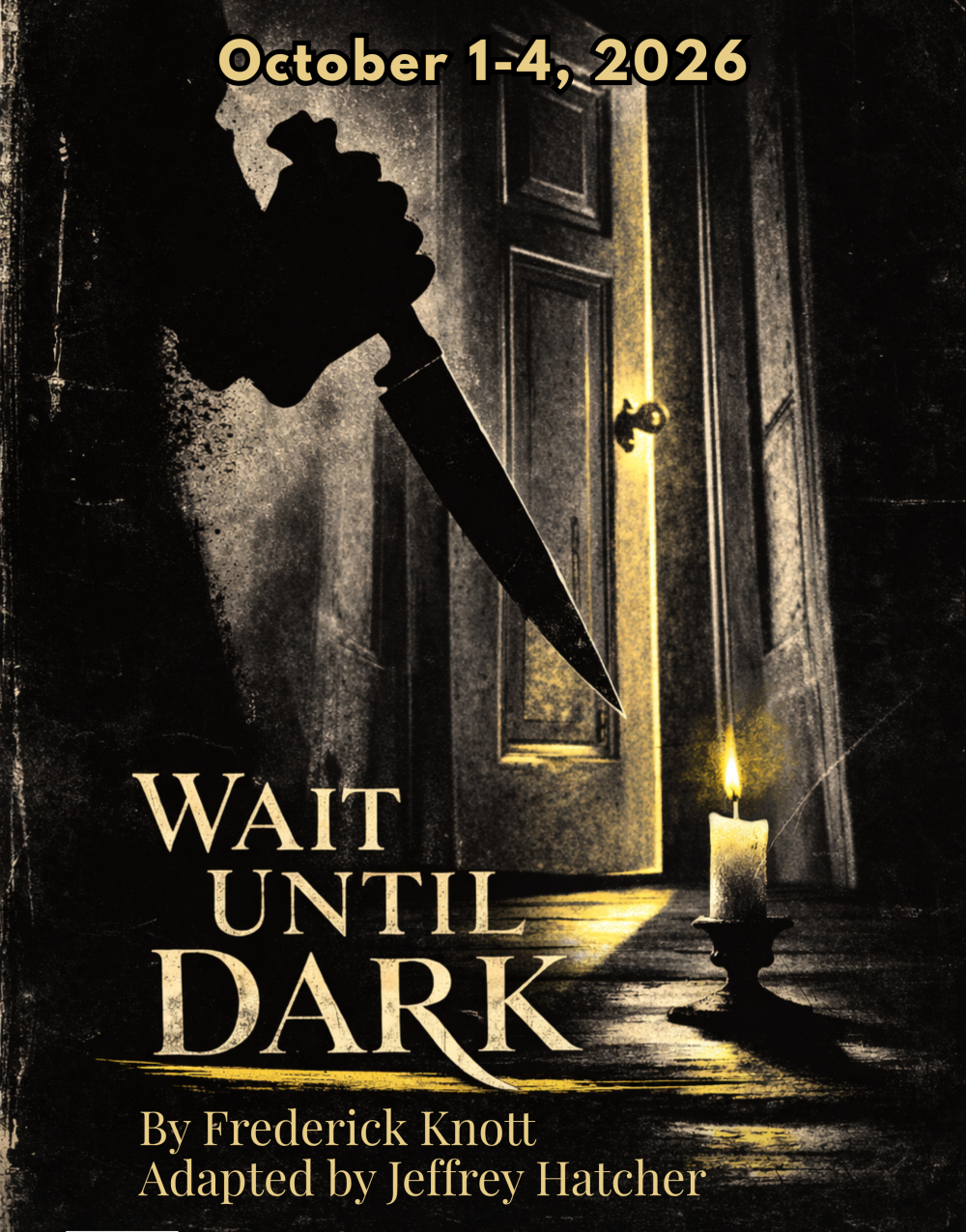
Wait Until Dark |
||
|
|
||
|
By Frederick Knott |
Adapted by Jeffrey Hatcher |
|
| Directed by Phil Gill | ||
| WAIT UNTIL DARK, adapted by Jeffrey Hatcher, was originally produced by the Geffen Playhouse, Randall Arney, Artistic Director; Ken Novice, Managing Director Behnaz Ataee, General Manager; Regina Miller, Chief Development Officer | ||
|
WAIT UNTIL DARK (HATCHER) (AMATEUR PERFORMANCE RIGHTS) is presented by arrangement with Concord Theatricals on behalf of Dramatists Play Service. www.concordtheatricals.com |
||
|
|
||
Follow Us:
Director's Note
When Wait Until Dark unfolds, New York City is still deep in the shadow of World War II. It is October 1944. Across the Atlantic, the war rages on, while at home Americans navigate rationing, uncertainty, and the constant awareness that the world has changed. Greenwich Village, where this story takes place, was already a vibrant neighborhood filled with artists, veterans, immigrants, and working families, all living through a moment when the future felt fragile and unknowable. The tension that runs beneath everyday life in that era becomes an important backdrop for this thriller.
Jeffrey Hatcher's adaptation wisely relocates the story from the 1960s to the 1940s, creating a world where information traveled more slowly, technology offered fewer safety nets, and people often had to rely on instinct, trust, and resilience. Susan Hendrix possesses all three.
As we prepared this production, our team spent time researching blindness and mobility tools of the period. Audiences today immediately recognize the white cane as a symbol of independence and navigation for blind and low-vision individuals. Yet in 1944, there was no universally adopted standard white cane. While white canes had begun appearing in parts of Europe and North America during the 1930s, the lightweight long cane and mobility techniques that are familiar today would not become widely developed and standardized until after World War II, particularly through rehabilitation programs for blinded veterans. Susan therefore inhabits a moment in history when blind individuals were often forced to invent their own systems of independence in a world that provided far fewer accommodations than we expect today.
That reality makes Susan's story all the more remarkable. At its heart, Wait Until Dark is not simply a suspense story. It is a story about perception. Who sees clearly? Who misses what is directly in front of them? Who possesses knowledge, and who possesses wisdom? The answers are far less obvious than they first appear. Theatre, too, asks us to trust our senses. We gather together in a room and agree to experience a story collectively. We listen. We imagine. We react. We share laughter, tension, and silence with hundreds of strangers. In many ways, we become aware of one another through the darkness itself. Long before the house lights dim, we are individuals. Once the performance begins, we become a community.
Tonight, as the shadows lengthen and the suspense builds, I invite you to embrace that shared experience. Let your imagination fill the spaces between what is seen and unseen. Listen closely. Stay present. And above all, enjoy the thrill of discovering this story together.
— Phil Gill, Director
Special Thanks
We would like to thank the following people for their support and vision for the Performing Arts Department:
- Board of Trustees
- Dr. Barbara Kavalier, President
- Dr. Amy Koehler, Provost/Chief Academic Officer
Amy Scheers, Interim Dean- School of Business, Technology, & Performing Arts
Laura Enstall, Academic Program Coordinator, Theatre
Thank you to all of the SCC staff in the following departments who work hard behind the scenes to help make every production a success:
- Department of Public Safety
- Facilities and Housekeeping Department
Cast
Creative Team
Phil Gill
Zac Carey
Jane Bagnall
Emma Miller
Sam Lanterman
Erik Kuhn
Sophie Kottman
Selah Harris
Frida Soto
Charlie Becker
Nathan Goodman
Will Kimbrel
Aiden Cleary
Zulielys Diaz Rijos
Hadessah Hanks
Vanny Gillespie
Maiah Fugate
Meet the Company
Olivia Nave
Rayan Davis
Zander Shure
Caleb Boughton
Anakin Ganolli
Leymar Canales-Sotomayo
Phil Gill
Zac Carey
Jane Bagnall
Emma Miller
Sam Lanterman
Erik Kuhn
Sophie Kottman
Selah Harris
Frida Soto
Charlie Becker
Nathan Goodman
Will Kimbrel
Aiden Cleary
Zulielys Diaz Rijos
Hadessah Hanks
Vanny Gillespie
Maiah Fugate